


Articles & Papers
Publication #1
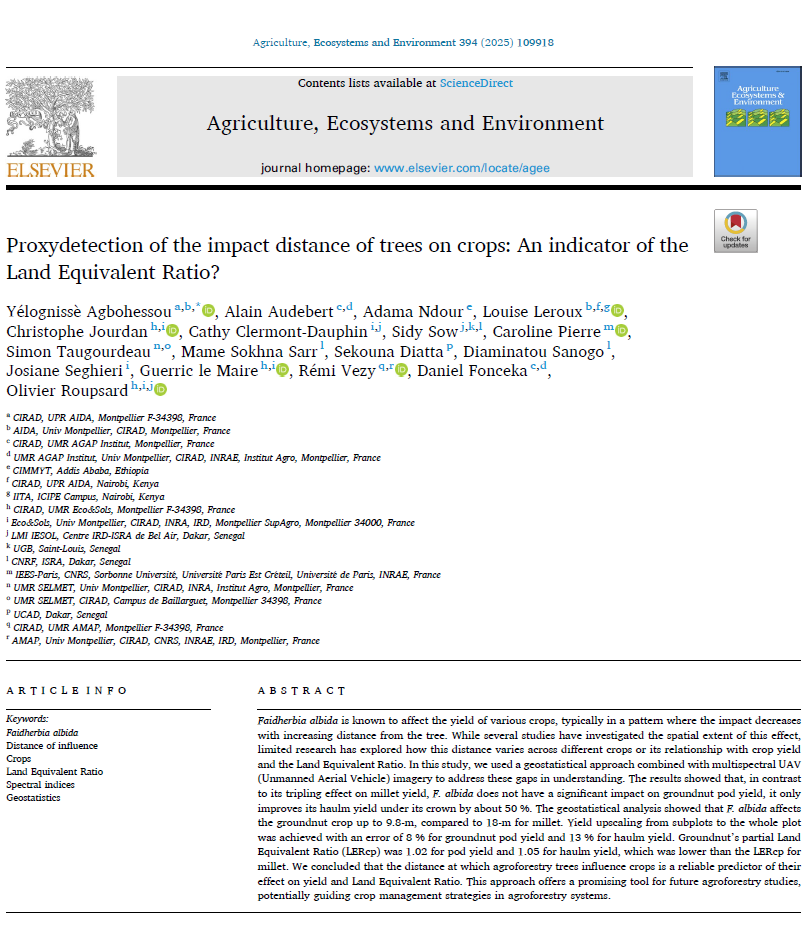
Proxydetection of the impact distance of trees on crops: An indicator of the Land Equivalent Ratio?
Yélognissè Agbohessou, Alain Audebert, Adama Ndour, Louise Leroux, Christophe Jourdan, Cathy Clermont-Dauphin, Sidy Sow, Caroline Pierre, Simon Taugourdeau, Mame Sokhna Sarr, Sekouna Diatta, Diaminatou Sanogo, Josiane Seghieri, Guerric le Maire, Rémi Vezy, Daniel Fonceka, Olivier Roupsard
Abstract
Faidherbia albida is known to affect the yield of various crops, typically in a pattern where the impact decreases with increasing distance from the tree. While several studies have investigated the spatial extent of this effect, limited research has explored how this distance varies across different crops or its relationship with crop yield and the Land Equivalent Ratio. In this study, we used a geostatistical approach combined with multispectral UAV (Unmanned Aerial Vehicle) imagery to address these gaps in understanding. The results showed that, in contrast to its tripling effect on millet yield, F. albida does not have a significant impact on groundnut pod yield, it only improves its haulm yield under its crown by about 50 %. The geostatistical analysis showed that F. albida affects the groundnut crop up to 9.8-m, compared to 18-m for millet. Yield upscaling from subplots to the whole plot was achieved with an error of 8 % for groundnut pod yield and 13 % for haulm yield. Groundnut’s partial Land Equivalent Ratio (LERcp) was 1.02 for pod yield and 1.05 for haulm […]
Publication #2
Drivers and vertical CO2 flux balances in a Sahelian agroforestry system: Insights from high frequency measurements
Seydina M. Ba, Olivier Roupsard, Lydie Chapuis-Lardy, Frédéric Bouvery, Yélognissè Agbohessou, Maxime Duthoit, Aleksander Wieckowski, Torbern Tagesson, Mohamed H. Assouma, Espoir K. Gaglo, Claire Delon, Bienvenu Sambou, and Dominique Serça
Abstract
Agroforestry systems – combining trees with crops and/or livestock – are increasingly promoted as sustainable and climate-resilient land-use strategies. Despite their widespread presence in the Sahel, experimental data on their potential as carbon sinks are scarce. This study presents a full-year, high-frequency dataset of CO2 fluxes in a Sahelian agro-silvo-pastoral parkland dominated by Faidherbia albida, located in Senegal’s groundnut basin. CO2 fluxes were continuously measured using automated dynamic chambers, allowing the quantification of soil and crop respiration (Rch), gross primary production (GPPch), and net carbon exchange (FCO2ch) under both full sun and shaded (under tree canopies) environments. Seasonal patterns of CO2 fluxes were similar in both environments, with peaks during the rainy season. Rch and GPPch were significantly higher under tree canopies, indicating a “fertile island” effect […]
Publication #3
‘Probabilistic Atlas’, a new approach to assess complexity in agroforestry systems using UAV images: example of the spatial effect of Faidherbia albida on pearl millet NDVI
Serigne Mansour Diene, Ibrahima Diack, Romain Fernandez, Alain Audebert, Olivier Roupsard, Louise Leroux, Abdoul Aziz Diouf, Harun Cicek, Moussa Diallo & Idrissa Sarr
Abstract
Trees in agroforestry parklands significantly contribute to improving and adapting farming systems while providing ecosystem services. However there is limited information on crop productivity and environmental performance. How do crop growth in such heterogeneous agroforestry systems vary according to distance, crown size, and azimuthal direction? We use a novel approach based on advanced image analysis derived from medical imaging combined with multispectral imagery (known as the “probabilistic atlas”) to analyze the crop, tree and soil interactions. We analyzed the influence of 72 Faidherbia albida trees on 13 millet fields in 2021 and 2022 using “Voronoi” diagrams to separate individual trees. The Normalized Difference Vegetation Index (NDVI), was used as an indicator to assess the tree effect on pearl millet crop. In this study, the probabilistic atlas is a spatially aggregated representation of Faidherbia albida influence, illustrating the mean NDVI distribution […]
Publication #4
Sensitivity of a Sahelian groundwater-based agroforestry system to tree density and water availability using the land surface model ORCHIDEE (r7949)
Espoir Koudjo Gaglo, Emeline Chaste, Sebastiaan Luyssaert, Olivier Roupsard, Christophe Jourdan, Sidy Sow, Nadeige Vandewalle, Frédéric C. Do, Daouda Ngom, and Aude Valade
Abstract
The Sahel region is characterized by its semi-arid climate and open-canopy agroforestry systems, which play an important role in global carbon dynamics. Parkland agroforestry has the potential to sequester carbon at an average rate of 0.4 tC ha−1 yr−1, which, if expanded to its maximum potential extent, would correspond to an additional carbon stock of approximately 558 TgC compared to treeless croplands. However, land surface models (LSM) used in global climate modeling struggle to represent carbon dynamics in these ecosystems due to the inadequate representation of deep-roots tapping groundwater during dry periods, key environmental control for many agroforestry systems such as the widespread parklands based on the phreatophytic species Faidherbia albida. This study explores the sensitivity of Faidherbia albida parklands to tree density and water availability (rainfall and soil water content in the capillary fringe of the groundwater table) using […]
Publication #5
Contrasting roles of ground, trees, ponds and grazing in carbon dioxide, methane and nitrous oxide fluxes of an African semi-arid savanna
Seydina M. Ba, Aleksander Wieckowski,Patrik Vestin, Jonas Ardö a, Olivier Roupsard, Ousmane Ndiaye, Seydina Ba, Claire Delon, Dominique Serça g, Torbern Tagesson a
Abstract
Understanding greenhouse gas fluxes in semi-arid ecosystems is critical for improving our understanding of biogeochemical cycles, particularly in underrepresented regions like the African Sahel. In these landscapes, greenhouse gas exchange arises from ground, trees, and water ponds, and is further shaped by environmental conditions and grazing. The carbon dioxide, methane, and nitrous oxide fluxes were quantified from these components in a Sahelian savanna in Senegal, while also assessing grazing impacts and environmental drivers (soil water content, temperature, vapor pressure deficit, photosynthetically active radiation). The ground was a net carbon dioxide sink during the rainy season but shifted toward neutrality or weak emission in the dry season, consistently acted as a methane sink, and was a year-round nitrous oxide source. Seasonal ponds were strong methane and […]