

20 April 2026
Written by Tata Ngome Precillia, Guimjeu Dongmo Landry, Woin Gam Aristide & Munu Fritz-Austin Ndam
From Grassroots to Governance: Scaling Agroforestry in Sub Saharan Africa through Living Labs and Innovation Platforms
Highlight
Agroforestry in Africa is more than planting trees – it is also about reshaping rural economies, strengthening resilience to climate change, and re imagining governance. In Galileo farmers and pastoralists remain at the heart of innovation, but the circle of stakeholders extends far beyond them. Researchers, extension agents, policymakers, NGOs, private sector actors, and international partners all play critical roles in defining, co designing, testing, and scaling agroforestry practices (Figure 1). Together, they form a dynamic ecosystem where grassroots realities meet national strategies, and where local experimentation informs global sustainability frameworks. In this way, agroforestry becomes not only a livelihood strategy but also a climate resilience pathway, linking African communities to international agendas for sustainable development and deforestation free supply chains.
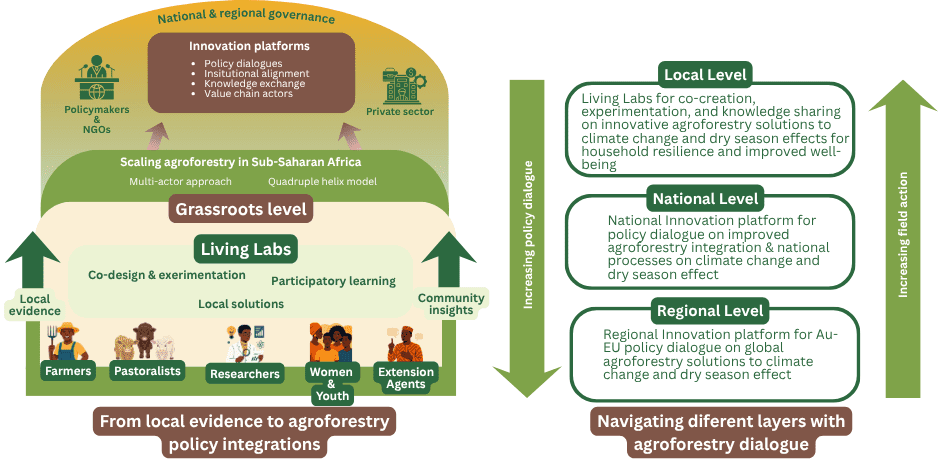
Figure 1: Agroforestry is not just about trees, but about systems, people, and governance
Context
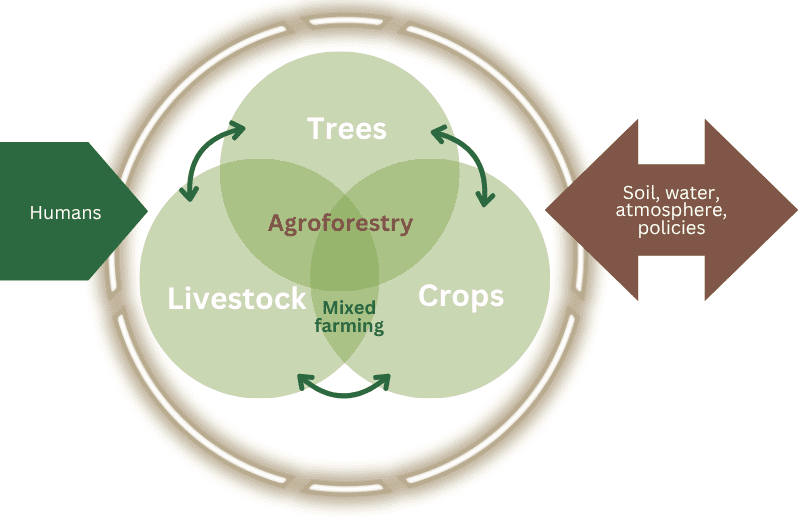
At Across Sub Saharan Africa, farmers, pastoralists, researchers, and policymakers are experimenting with ways to make trees central to climate smart agriculture. But the real challenge lies in connecting grassroots innovations to national and regional frameworks that can sustain them making agroforestry no longer just a farming technique but a governance issue. From this perspective, defining and working on agroforestry is complex (Figure 2). The complexity of capturing the concept of agroforestry lies in its multidimensional nature. Agroforestry is not a single practice but a spectrum of land‑use systems that integrate trees with crops and livestock, ranging from cocoa agroforestry in humid forests to hedgerows and silvo‑pastoral systems in drylands. This diversity makes it difficult to arrive at one universally accepted definition but also gives the basis for Galileo’s concept of innovative agroforestry.
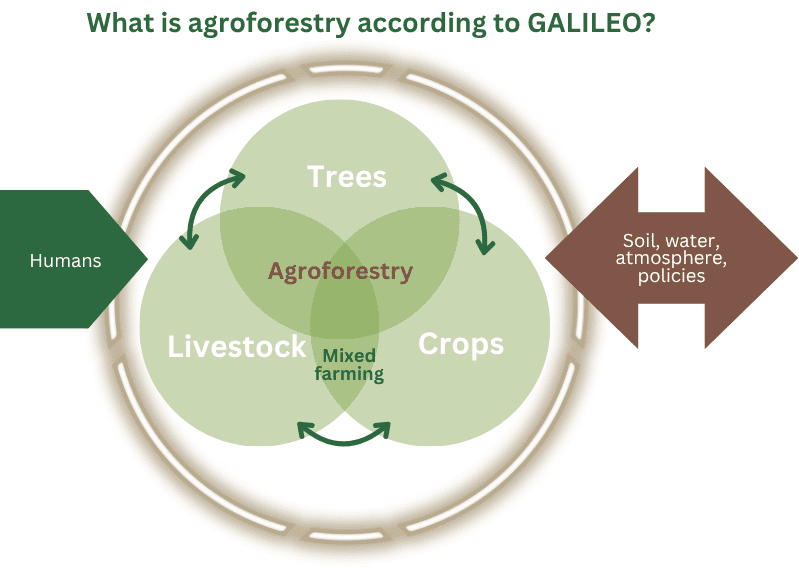
Figure 2: Complexity of capturing the concept of Agroforestry
Furthermore, agroforestry is a complex, context‑specific system that integrates trees with crops and livestock to enhance livelihoods, biodiversity, and climate resilience, but its definition is limited by ecological diversity, governance fragmentation, and equity challenges that make a single universal understanding difficult to achieve. Therefore, agroforestry is globally defined as the intentional integration of trees and shrubs into agricultural and pastoral systems to enhance productivity, biodiversity, and resilience while supporting rural livelihoods and climate change adaptation. It combines ecological science with farming and livestock practices to deliver co‑benefits such as soil fertility improvement, carbon sequestration, and diversified incomes.
However, this definition has limitations – it risks oversimplifying the diversity of agroforestry practices across different ecological zones (e.g. cocoa agroforestry in humid forests versus hedgerows in drylands), it does not fully capture governance challenges such as tenure insecurity and policy fragmentation, and it overlooks equity issues like gender and youth exclusion. In practice, agroforestry must be understood as a flexible, context‑specific system shaped by local realities, institutional frameworks, and international sustainability agendas. This constitutes a key strength and entry point of the GALILEO project, centred on the establishment and coordination of multi actor partnerships through an action plan that brings together 8 Living Labs, 4 national innovation platforms, and 1 regional innovation platform.
Living Labs: Innovation Rooted in Reality
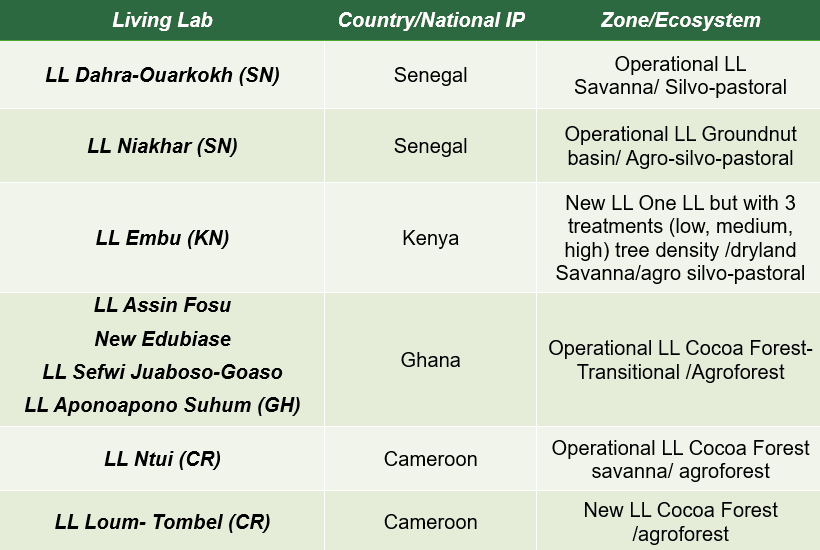
Within Galileo, farmers and pastoralists constitute at least 50% of living Labs (LLs) stakeholders. LLs are participatory spaces, they are “agoras” where everyday practices meet scientific experimentation and field actions (Table 1).
Table 1: Living lab and agroforestry systems for testing
-
Organising inception workshops where a shared vision and common goals are defined together
-
In Cameroon, LLs focus on cocoa agroforestry, shade tree planting, and livestock integration.
-
In Senegal, hedgerows and fodder trees are tested to fight drought and restore biodiversity.
-
In Ghana, canopy management and certification schemes link cocoa farmers to global markets.
-
In Kenya, experiments with tree density and crop diversification aim to balance productivity with resilience.
By embedding innovation in local agroecological zones, LLs ensure that solutions are not imposed but co created, reflecting the lived realities of rural communities.
Where Practice Meets Policy – Innovation Platforms
Complementing LLs are Innovation Platforms (IPs) at national (4) and regional (levels. These are governance incubators spaces where evidence from the field is translated into policy dialogue. Government agencies, NGOs, and private sector actors deliberate on land tenure, regulatory bottlenecks, and climate strategies. The goal is coherence: ensuring that grassroots experimentation informs national programs and regional cooperation.
Tackling Tensions: Land, Power, and Equity
Scaling agroforestry isn’t without conflict. The study suggests recurring tensions:
-
Land tenure insecurity in Cameroon limits farmers’ ability to invest in trees.
-
Regulatory compliance in Ghana, especially with deforestation free frameworks, challenges smallholders tied to informal supply chains.
-
Youth exclusion from land ownership in Kenya undermines generational continuity.
-
Gender inequities across all sites distort who benefits from agroforestry.
Yet, inclusive mechanisms women’s nursery enterprises, co management agreements, and community bylaws show promise in creating fairer outcomes.
Measuring Impact: Beyond Numbers
Key Performance Indicators (KPIs) track adoption rates, gender participation, and policy engagement. But the deeper story lies in how participation shifts power. Women and youth, once sidelined, are now central actors. Farmers are not passive recipients of innovation but co designers. Policymakers are learning to listen, and donors are being challenged to align priorities with local realities.
Regional Lessons: Balancing Global and Local
Across Cameroon, Senegal, Ghana, and Kenya, one lesson stands out: agroforestry is both local and global. It must reconcile EU deforestation regulations with informal supply chains, balance donor rigor with feasibility, and integrate climate strategies with livelihood needs. Living Labs and Innovation Platforms together create a dynamic ecosystem where practice informs policy and policy supports practice. They are not just experimental spaces but governance incubators bridging grassroots agency with institutional framework. To conclude, agroforestry in Africa is more than planting trees. It’s about re imagining governance, equity, and resilience. Success depends on balancing global frameworks with local realities, ensuring that farmers and pastoralists remain at the center of innovation.
The GALILEO project demonstrates that scaling agroforestry requires balancing global sustainability frameworks with local socio‑ecological realities, ensuring that innovations are both feasible and equitable. Stakeholder engagement has emerged as the cornerstone of Living labs and innovative platform design. Living Labs function as participatory spaces where grassroots actors collaborate with researchers and policymakers to design, test, and validate agroforestry practices in real‑life settings. Farmers and pastoralists anchor innovations in lived realities, ensuring that agroforestry practices respond to immediate livelihood needs such as fodder provision, soil fertility, and income diversification. Researchers contribute technical expertise, designing experiments and monitoring outcomes, while extension agents facilitate knowledge transfer. Policymakers and NGOs provide institutional support, aligning Living Lab activities with national strategies and donor priorities. Private sector actors, particularly those in value chains such as cocoa and dairy, integrate outputs into broader markets, creating pathways for commercialization and scaling.
On a downside, power imbalances often emerge, with donor agendas overshadowing farmer priorities, or policymakers privileging compliance with global frameworks over local feasibility. Farmers may feel marginalized when immediate livelihood concerns are subordinated to long‑term sustainability goals. Similarly, pastoralists often face exclusion in contexts where land tenure systems favor crop farmers, leading to conflicts over resource allocation. Effective stakeholder engagement requires conflict‑sensitive approaches that recognize these dynamics. Participatory tools that map actors’ roles and influence have proven useful in identifying potential synergies while farmer field schools embedded within Living Labs facilitate co‑design, ensuring that innovations are not externally imposed but collaboratively developed. Innovation Platforms complement this by providing structured spaces for policy dialogue, where grassroots evidence can be translated into institutional frameworks. To conclude, “scaling agroforestry in Africa requires not only trees in fields but trust in institutions – Galileo works on innovative agroforestry to show how both can grow together.”